MIH Is No Child's Play: How Chalky Teeth Affect Young Patients
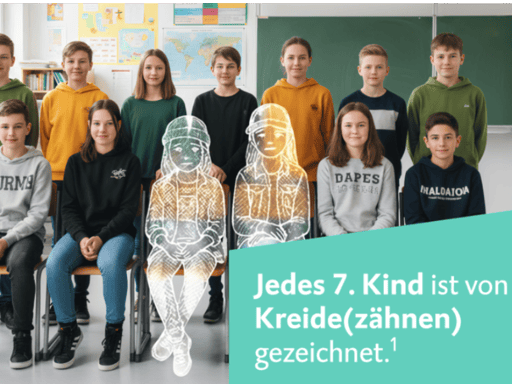
At a glance:Prevalence: In Germany, one in seven 12-year-old children is affected by MIH (15.3 %; DMS 6).1Symptom burden: In addition to aesthetic impairments that can affect social interactions, those affected often suffer from hypersensitivity, which makes eating and tooth brushing difficult.2,3Structural risk: MIH Teeth often show increased protein and decreased mineral content and are therefore porous, which can lead to increased susceptibility to posteruptive enamel loss and the development of carious lesions. 1,4,5 Not for the first time this month, a child with white, yellowish or brown spots on the Teeth comes into your treatment room. You can surely imagine how this must feel for the affected children. Think back to your first day of school, for example. The excitement, new people and unfamiliar faces – smiling with chalk Teeth? Actually unthinkable. Children with molar-incisor hypomineralisation (MIH) are no rarity in reality and can meet you regularly in your daily practice. A lack of treatment strategy for MIH or "wait and see" can be frustrating: for children, concerned parents and for you as the treating physician. MIH: more than a marginal issueA child with MIH is not an isolated case, but can be everyday reality in your practice. The numbers speak for themselves. In Germany, on average one in seven 12-year-old children suffers from MIH, which corresponds to a prevalence of 15.3 %.1 This makes it clear: MIH, colloquially known as chalk Teeth, is a condition that affects many children and whose treatment deserves attention. Although approximately 63.3 % of MIH cases are mild, early diagnosis is advantageous for the further course of the disease.1,6 Patients in focus: Everyday life with MIHPerhaps the high number of cases is also reflected in your daily practice.But what does the diagnosis MIH mean for your young patients and how do they live with it? Especially in everyday life, MIH can have far-reaching effects on the quality of life of children and can mean a daily challenge for those affected.3 From visibility to perceptibilityThe effects of MIH on your patients' lives can be very varied. Sentences like: "Why don't you brush your Teeth properly?" or "Why are your Teeth so strange?" can be hurtful and are full of prejudices. This makes it clear that in particular the discoloration of the incisors affects the aesthetic (self-)perception of those affected and can be stressful.7,8 MIH means many symptoms for those affected that go beyond aesthetics. Patients often suffer from sensitive Teeth, which can lead to problems in everyday life.3 Whether it's during tooth brushing, while consuming hot and cold food or while chewing.2,3These physical symptoms can also affect daily life and mental health, as they can significantly affect quality of life.3 The tooth structure in focus: What happens in the enamelWhy are MIH-affected Teeth often sensitive, porous and visually altered at the same time? A look beneath the Finish provides the decisive clues. Many of the clinically visible and perceptible features are caused by histological changes in the Tooth. The protein content of the Teeth is increased, the mineral content is lower and as a result the Tooth is porous, which if left untreated can increasingly lead to enamel fractures.1,4 Furthermore, there is evidence that MIH Teeth have an increased risk of caries, which can present patients with further challenges.5 Now (treat)?The combination of visible changes, hypersensitivity and structural Special features of the hard dental tissue illustrates the need for clear diagnostic and therapeutic concepts in your daily practice. Given the high prevalence, the question arises as to how you can meet the treatment needs in your practice in a structured manner. MIH treatment in your practiceThe numbers and symptoms of those affected speak for themselves and show that MIH treatments can also play a regular role in your practice. With 100 pediatric treatments per month, 13 to 15 MIH cases can be expected statistically.1 The good news for you and your patients? There are modern, minimally invasive treatment methods that can be efficiently integrated and implemented in your daily practice. If you have the right answers for your patients, this not only builds trust with those affected and their families, but also positions your practice strategically. Because with MIH: patient loyalty begins early and an appropriate treatment strategy can be the basic prerequisite for working hand in hand with the entire family. Sources1. Jordan R et al. DMS 6 Bekes K et al. 2025; 70–4. 2. Schwendicke F et al. J Dent. 2018; 68: 10–8. 3. Joshi T et al. Clin Oral Investig. 2022; 26: 1753–9. 4. Farah RA et al. J Dent. 2010; 38: 591–6. 5. Americano GCA et al. Int J Paediatr Dent. 2017; 27: 11–21. 6. Lygidakis NA et al. European Archives of Paediatric Dentistry. 2021; 23: 3–21. 7. Hasmun N et al. J Dent. 2020; 98. 8. Hasmun N et al. Dent J (Basel). 2018; 6.